

Speciality cables from FEMTO
Why are special cables required?
In precision measurement technology, the overall performance of a system is not solely determined by amplifier specifications. The connecting cable between the signal source and the amplifier is an integral part of the signal path. Particularly with ultra-low-noise current amplifiers (transimpedance amplifiers – TIAs), unsuitable cables can massively degrade the signal-to-noise ratio (SNR). Therefore, FEMTO offers special cables for various applications. Using these cables at the amplifier's input and output can lead to an overall significantly more accurate and less noisy measurement setup.
Which cable for which amplifier input?
To simplify cable selection for connecting the source, please use the following matrix based on your FEMTO amplifier model
Detailed technical information on which cable is recommended for which amplifier and for what reasons can be found in our Cable selection guide.
| Amplifier Series |
Typical Application |
Recommended FEMTO cable |
Why? |
|---|---|---|---|
| LCA DLPCA-200 DDPCA-300 |
Current measurement, high gains (>105) with bandwidths below 1 MHz | Low-Noise | Eliminates vibration artefacts at high gains |
| Low-Capacitance | For cable lengths over 1 m in a mechanically undisturbed environment, to minimise capacitively induced noise | ||
| HCA DHPCA-100 |
Current measurement, bandwidths of 1 MHz to 100 MHz | Low-Capacitance | Keeps the capacitively conditioned noise floor flat at high frequencies |
| RF cable | For 50 Ω Impedance matching and/or in an electromagnetically disturbed environment | ||
| DLPVA HVA DHPVA HSA DUPVA |
Voltage measurement, bandwidths from DC to GHz | RF cable | The source capacitance plays a subordinate role, focus on maximum EM shielding and 50 Ω impedance matching |
| Lock-In-Amplifiers | Lock-In Detection | Low-Noise | In a mechanically disturbed environment (vibrations) |
| RF cable | In an electromagnetically stressed environment |
Which cable for the output?
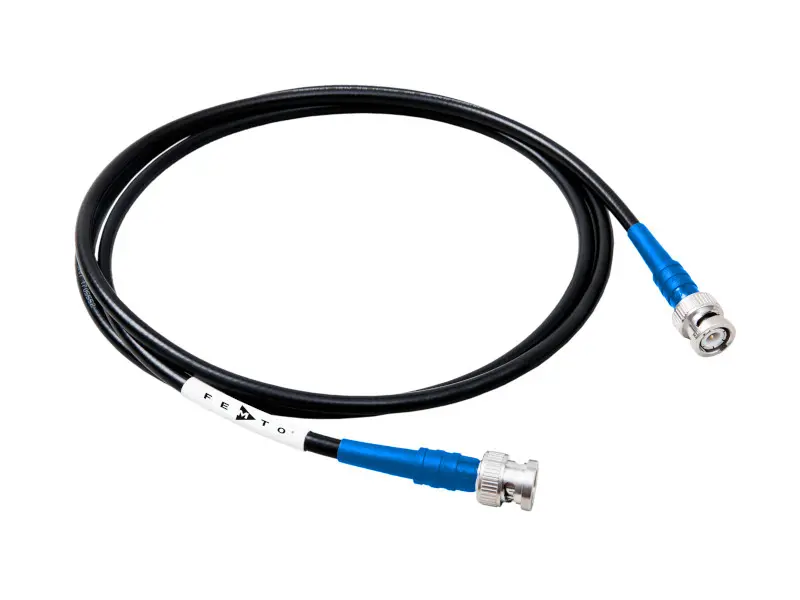
For connecting our amplifiers and photodetectors to the signal receiver (e.g. oscilloscope or ADC card), we recommend without exception our RF cable, to minimise interference.


 English (UK)