

Brief description
OE-200-BPR are balanced photodetectors for measuring small differential photocurrents or small optical differential powers with bandwidths in the kHz range. They have nine switchable gains and feature an outstanding Common Mode Rejection Ratio (CMRR) of 50 dB.
Features
- Bandwidth up to 500 kHz
- Common Mode Rejection Ratio (CMRR) typically 50 dB
- Very low noise, NEP down to 6 fW/√Hz
- Si and InGaAs models for spectral range from 320 to 1700 nm
- Switchable 10 Hz low pass filter to minimise wideband noise
- Adjustable conversion gain from 103 to 1011 V/W
- Switchable AC/DC coupling
- Input fiber-coupled
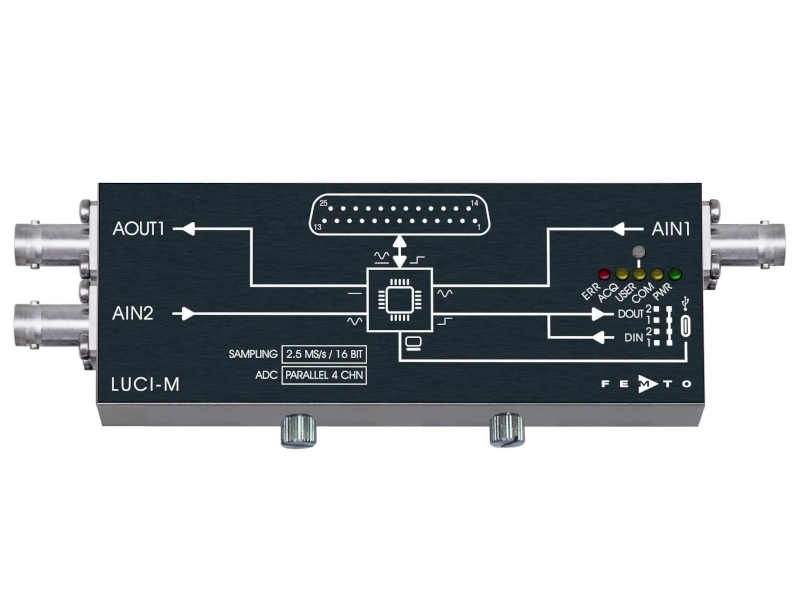
- Fully compatible with the LUCI-M USB remote control and data acquisition system
- Remote control is also possible using the LUCI-10 USB adapter
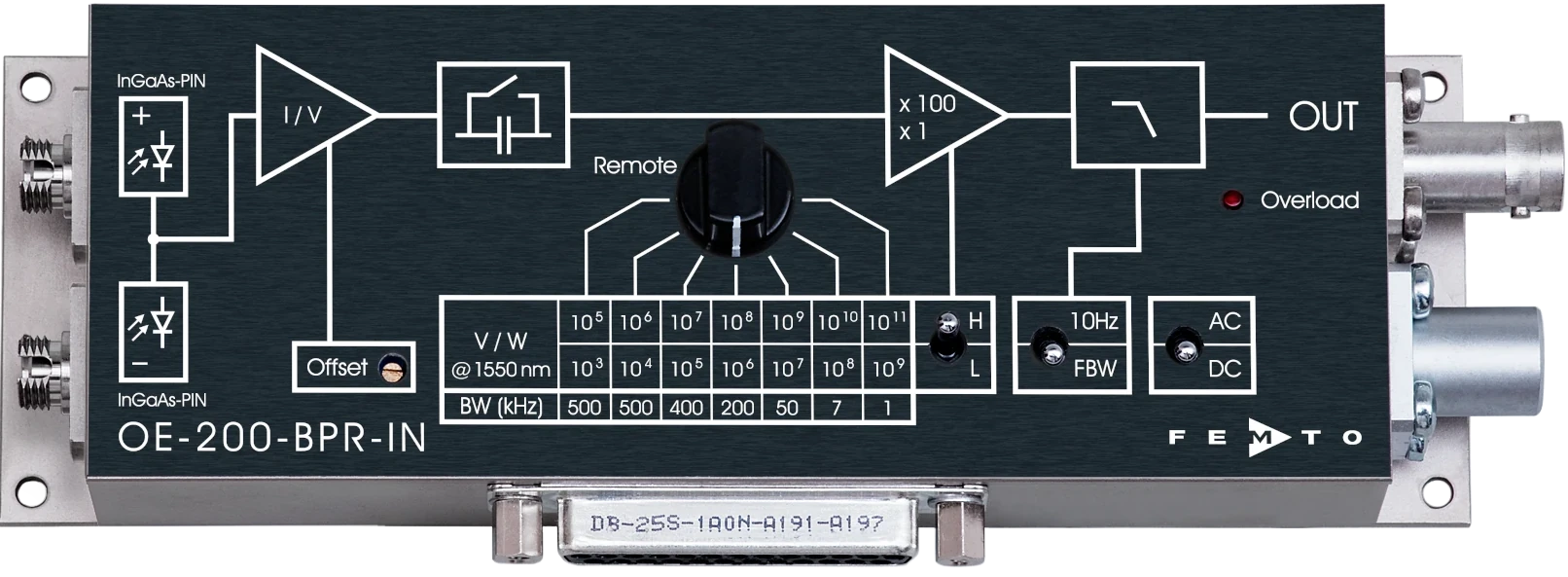
| Model | OE-200-BPR-SI-FC | OE-200-BPR-IN-FC |
|---|---|---|
| Detector Type | Si-PIN | InGaAs PIN |
| Detector size | 1.2 mm diameter | Ø 80 µm (integrated ball lens) |
| Spectral Range [nm] | 320 - 1060 | 900 - 1700 |
| Calibration wavelength [nm] | 850 | 1550 |
| NEP (dependent on gain) [/√Hz] | 13 fW – 40 pW | 6 fW – 21 pW |
| Datasheet |  |
|
| Request a Quote |  |
|
The following specifications apply to all OE-200-BPR models:
| Performance Range | Low Noise | High Speed | ||||||||||||
|---|---|---|---|---|---|---|---|---|---|---|---|---|---|---|
| Conversion gain at calibration wavelength [V/W] | 103 | 104 | 105 | 106 | 107 | 108 | 109 | 105 | 106 | 107 | 108 | 109 | 1010 | 1011 |
| Bandwith (-3 dB) [kHz] | 500 | 500 | 400 | 200 | 50 | 7 | 1.1 | 500 | 500 | 400 | 200 | 50 | 7 | 1.1 |
| Rise Time (10 % - 90 %) |
700 ns | 700 ns | 900 ns | 1.8 µs | 7 µs | 50 µs | 300 µs | 700 ns | 700 ns | 900 ns | 1.8 µs | 7 µs | 50 µs | 300 µs |
| Common-mode rejection ratio (CMRR) | 50 dB typical | |||||||||||||
| Accuracy Performance | ±5 % (@ Popt ≤ 1 mW at calibration wavelength) | |||||||||||||
| Low Pass Filter | Switchable to 10 Hz | |||||||||||||
| Output | ±10 V (@ ≥10 kΩ Load) | |||||||||||||
| Power Requirements | ±15 V, +110 mA/−80 mA typ., ±200 mA recommended | |||||||||||||
| Control Interface | 5 opto-isolated digital inputs, TTL/CMOS compatible, analog offset control voltage input | |||||||||||||
Offset adjustable by potentiometer and external control input, compatible with LUCI-M. Output short-circuit protected. Power supply via 3-pin Lemo® socket. A mating connector is provided with the device. Optional power supply PS-15 available. For further information please view the datasheet or contact FEMTO.
Cable recommendation
For detailed information on which cable we recommend for which application and why, please see our Cable Selection Guide.| Recommended FEMTO cable | Why? | |
|---|---|---|
| Output | RF cable | Focus on maximum EM shielding and/or 50 Ω impedance matching |
Customised products
Do none of the products fulfil your requirements? We offer customer-specific versions of our products, e.g. adapted bandwidth, amplification or optimisation for special signal sources. OEM versions, for example for larger projects and product integrations, are also possible. Our technical support team looks forward to your enquiry. You may also find something suitable among the related products.
| Model | HBPR-100M-60K-IN-FST HBPR-100M-60K-IN-FS HBPR-100M-60K-IN-FC |
|---|---|
| 10 mW on each photo diode | |
| Low Pass Filter | Full bandwidth switchable to 20 MHz (upper cut-off frequency) |
| High pass filter (AC coupling) | DC coupling switchable to AC (10 Hz lower cut-off frequency) |
| Signal output voltage | ±1.0 V at 50 Ω load (for linear gain and low harmonic distortion), maximum ±2.0 V at 50 Ω load |
| Monitor outputs | transimpedance gain 1000 V/A, bandwidth DC - 10 MHz, output voltage 0 ... +10 V (@ ≥100 kΩ load) |
| Supply voltage / Supply current | ±15 V (±14.5 V ... ±16.5 V) -90 / +120 mA typ. |
| Case | 80 x 80 x 30.5 mm (L x W x H) Weight FC models 350 g (0.77 lbs), weight FS/FST models 410 g (0.9 lbs) |
Fully compatible with LUCI-M
By connecting the D-Sub 25-pin plug and socket, the USB control and data acquisition system LUCI-M and the balanced photoreceiver OE-200-BPR form a compact unit that functions as a single, remotely controllable measurement system. No cabling is required between LUCI-M and OE-200-BPR, keeping the setup compact and tidy.
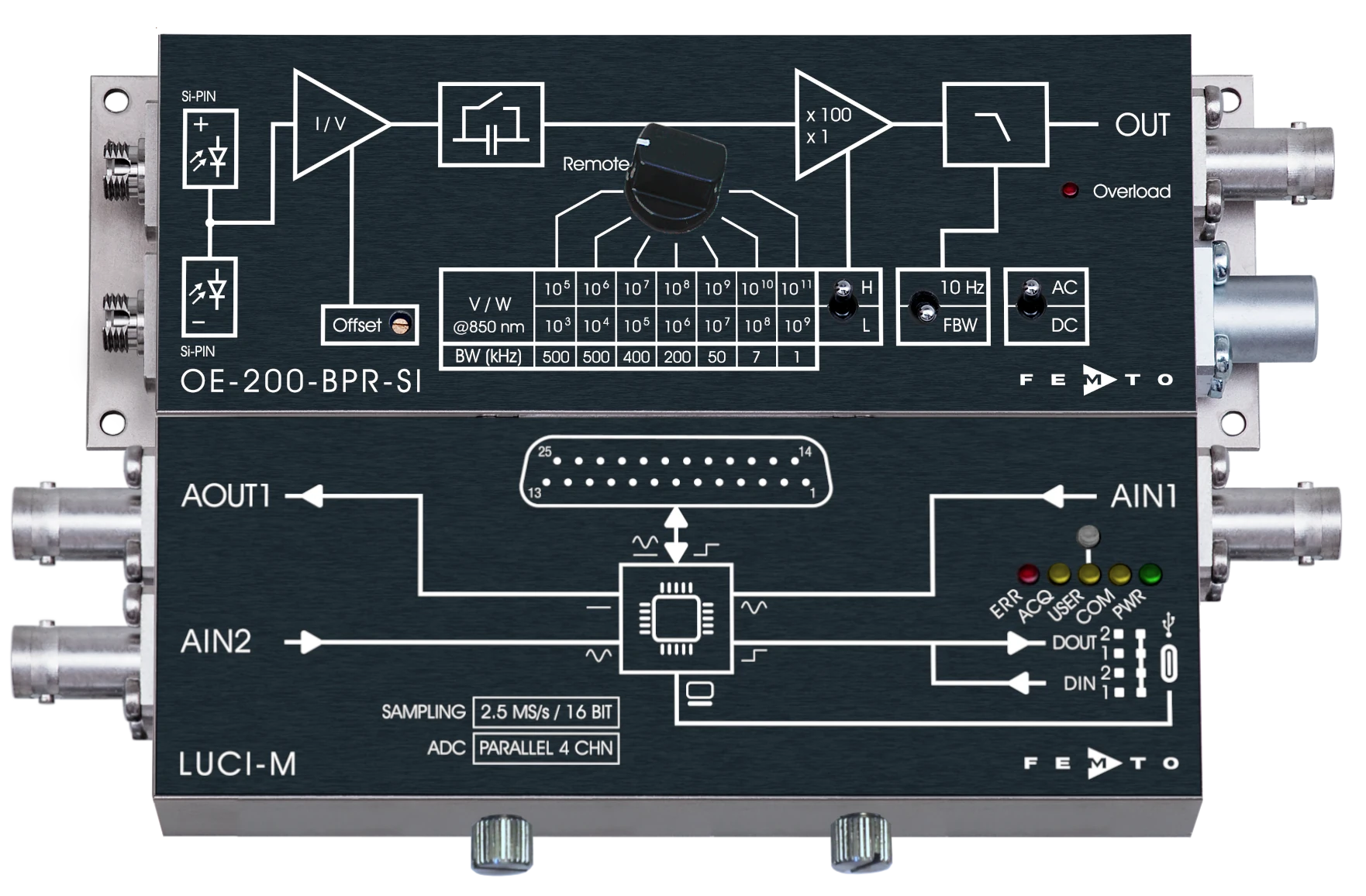
Figure: LUCI-M in combination with OE-200-BPR as an application example
The entire system offers the following features:
- Reading the output signal using a 2.5 MS/s ADC
- Switching the gain
- Switching between Low Noise and High Speed
- Toggling the AC/DC coupling
- Reading the overload status
- Setting the offset compensation voltage using DAC
For example, this allows for measurements with automatic gain switching when values exceed or fall below certain thresholds, without the need for additional peripherals.
Detection of smallest optical difference signals from DC up to 500 kHz
By taking the exact difference between the two input signals, common-mode noise, such as the intensity noise of the laser source used, is suppressed. This way, smallest optical signals can be extracted from the signal measurement path that would otherwise be buried in the noise.
The OE-200-BPR series photoreceivers/photodetectors comprise a pair of anti-parallel connected photodiodes followed by a low-noise transimpedance amplifier. The low input noise (NEP) and excellent common-mode rejection set new standards for balanced photoreceivers in the MHz range and enable highly sensitive signal detection. The nine switchable gain settings allow adjustment for virtually any light output, from fW to mW, and open up a wide range of applications.
Thanks to additional features such as switchable bandwidth limitation (low-pass filter), adjustable offset, and switchable AC/DC coupling, the photoreceivers in the OE-200-BPR series are among the most versatile balanced photoreceivers.
Suitable for optical bench
All OE-200-BPR photodetectors are compatible with the PRA-PAP adapter plate. This allows for retrofitting UNC 8-32 and M4 threaded holes, enabling simple and stable integration on the optical bench.
Applications
- Optical spectroscopy
- Coherent heterodyne detection
- Homodyne detection of optical quantum states
- Interferometric measurements
- Differential optical front end for oscilloscopes, spectrum analysers, A/D converters and lock-in amplifiers




 English (UK)