

Brief description
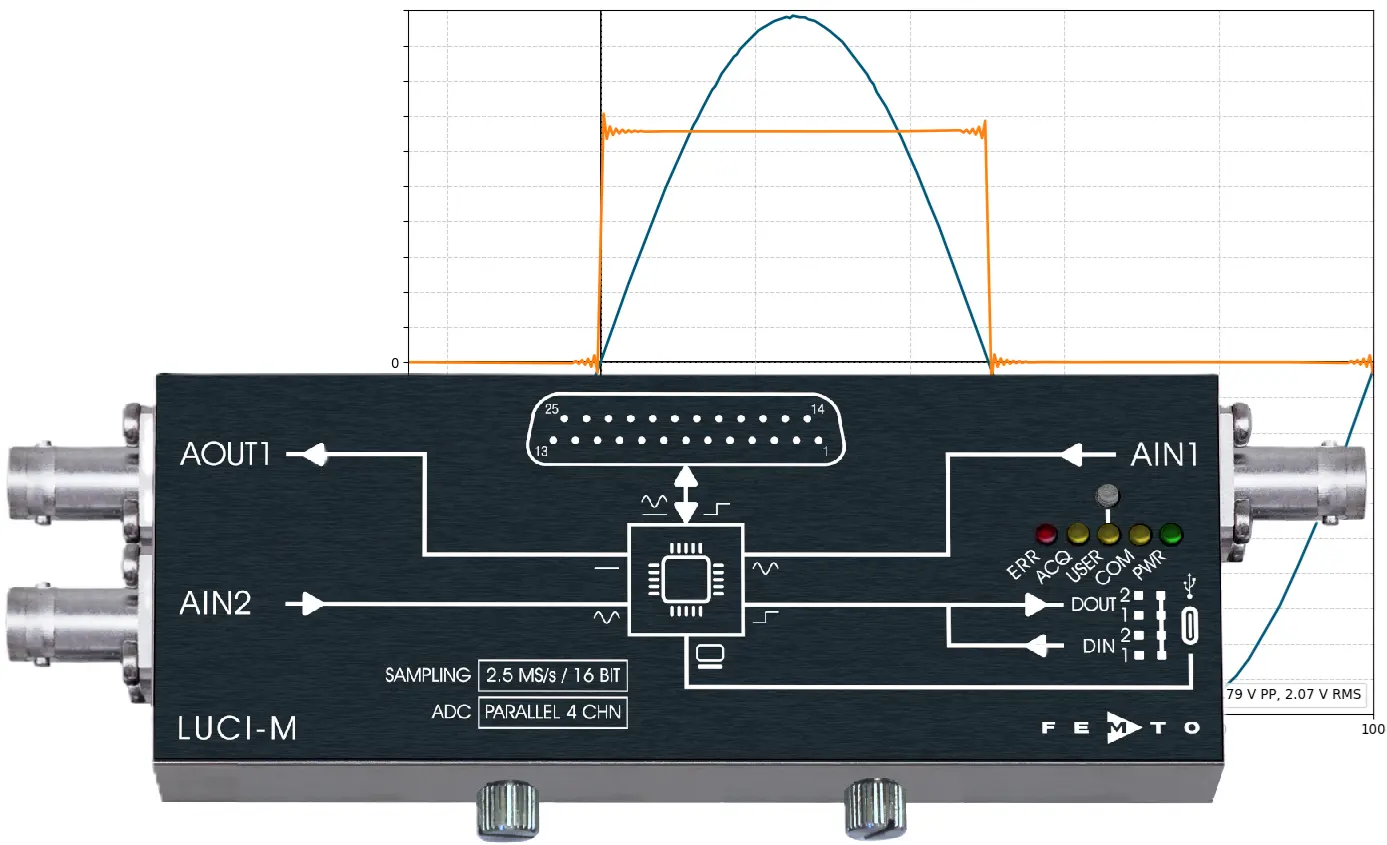
Compact, universal USB system for data acquisition and control. Freely assignable ADCs digitise measured values, DACs control external devices or serve as bias voltage sources. Digital I/Os read status and alarm signals and switch external peripherals. Ideal for FEMTO amplifiers and photodetectors. Easy to use for universal measurement and control tasks. Galvanic isolation from PC ensures highest signal quality and minimises noise.
Features
- 2 or 4 parallel channels (depending on model), 16 bit ADC with 2.5 MS/s
- 3-channel, 12 bit DAC
- Galvanic isolation from Computer
- A total of 19 digital outputs
- A total of 5 digital inputs
- SCPI-compatible command set
- Driver for Microsoft Windows®
- Direct access on macOS® and Linux® (no driver required)
- Python source code examples and GUIs are available as optional downloads
| LUCI-M | |
|---|---|
| Bus interface | USB 2.0 (Hi-Speed) |
| Supply | USB port or USB PD (5 V, 3 A required) |
| Connectors | USB type C, D-Sub 25-pin connector, 3 BNC female, 8-pin port for digital I/O |
| Analog-digital converter |
2 or 4 parallel channels (depending on model) , 16 bit, 1.1 MHz analogue bandwidth, 2.5 MS/s, downsampling to 500, 100, 10 and 1 kS/s selectable |
| Analog inputs |
A total of 6, 2 BNC, 4 on pins of the D-Sub connector. All can be assigned to the ADC channels as required |
| Digital-to-analog converter |
3 channels, 12 bit |
| Analog outputs |
3 in total, 1 BNC, 2 on pins of the D-Sub connector. |
| Digital I/O | A total of 19 outputs and 5 inputs |
| Command set |
SCPI-compatible |
| Datasheet |  |
What is LUCI-M?
LUCI-M is a universal data acquisition and control system. It connects via USB and offers two or four - depending on the model - freely assignable analog-to-digital converters (ADC) for acquiring and digitising measured values. Three digital-to-analogue converters (DAC) are also available, for controlling external devices or as a source for bias and offset voltages. A total of 24 additional digital I/Os are used to read status or alarm messages and to switch further peripherals.
Of course, The LUCI-M is tailored to FEMTO amplifiers and photodetectors, forming a versatile measurement and control unit when used with them.
Remote control of FEMTO amplifiers and photodetectors
The LUCI-M system is suitable for remote control of all FEMTO amplifiers and photodetectors with a 25-pin D-Sub socket. Depending on the amplifier or photodetector used, all important functions such as gain, AC/DC switching, or filter settings can be controlled remotely. In addition, status information such as “overload” or “unlocked” can be queried.
The LUCI-M is plugged directly into the D-Sub 25 socket and screwed in place. In this way, the LUCI-M and amplifier or photoreceptor form a compact unit and combine to form a single device.
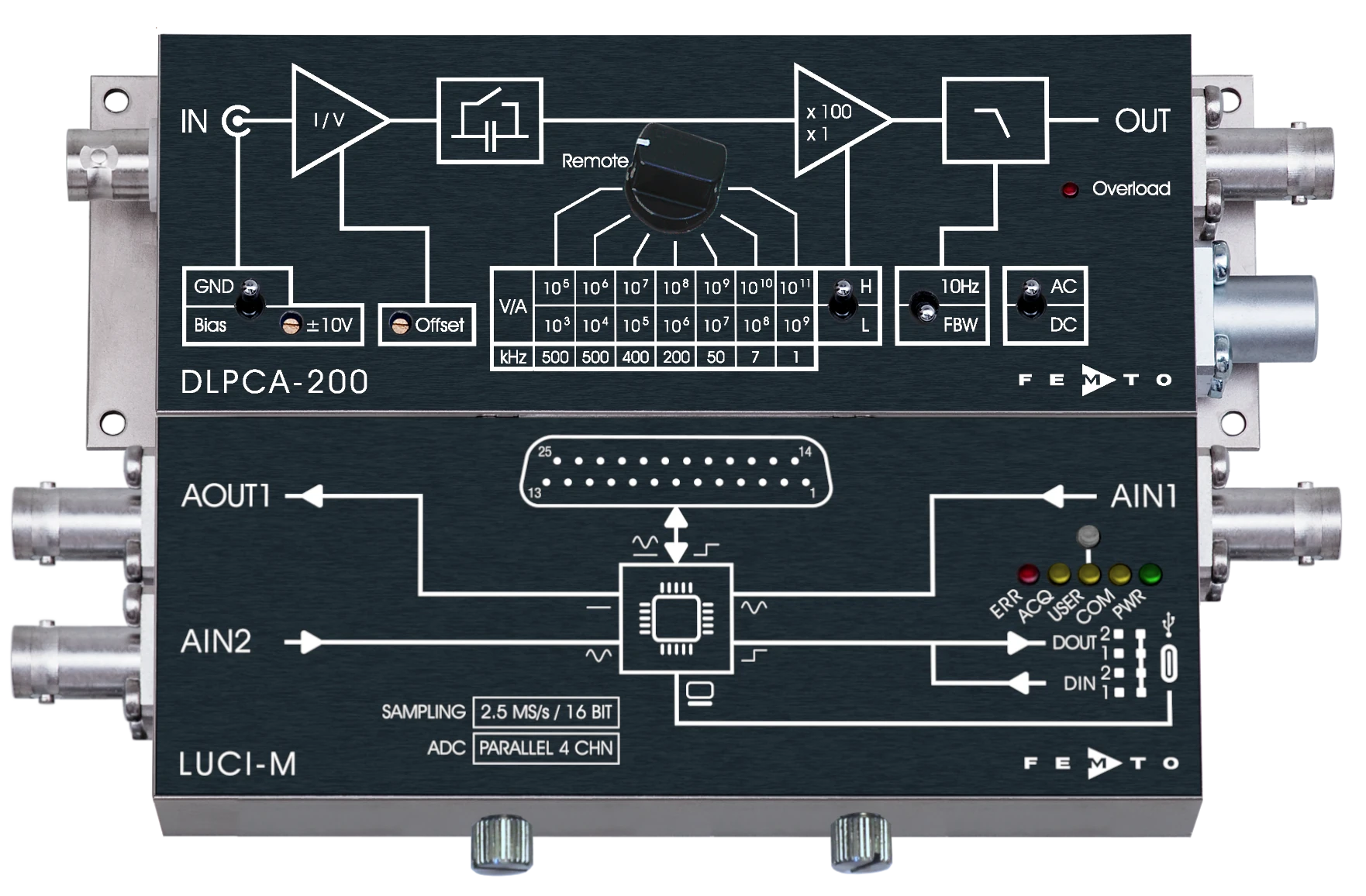
Figure: LUCI-M in combination with DLPCA-200 as an application example
Data acquisition, ADCs, and DACs
The LUCI-M has ADCs. This allows the output signal to be recorded directly. No external data acquisition system (DAQ system) is required. The DACs also enable bias and offset voltages to be applied. In both cases, the D-Sub connection is used and no cables are required between the amplifier or photodetector and the LUCI-M. The setup remains compact and tidy.
External inputs and outputs are also available. These can be used, for example, to simultaneously record additional measured values from other sources, again without the need for an additional external DAQ system.
The ADCs and DACs can be used independently of FEMTO products, making the LUCI-M system an alternative to established USB DAQ systems. If no FEMTO amplifier or photodetector is connected, the D-Sub interface can be used freely with breakout or cable clamp adapters, resulting in a wide range of connection and usage options.
Galvanic isolation
The analogue signals at the inputs and outputs are galvanically isolated from the computer. This keeps the computer's “EMC noise” away from the amplifier or photodetector and at the same time prevents potential problems and ground loops.
Communication and Interface
Communication with the LUCI-M is carried out using SCPI commands. SCPI, often referred to as “Skippy” and written out as Standard Commands for Programmable Instruments, is a standardised command set used to control and program measuring devices. SCPI is maintained and supported by many measuring device manufacturers. SCPI commands are transmitted in the form of ASCII text and can be generated with any programming language in any development environment.
Thanks to its SCPI-compatible command set and USB interface, the LUCI-M is not tied to any specific computer hardware, software, or programming language. It is platform-independent.
Software Examples
There are Python scripts available that demonstrate communication with the LUCI-M. They provide a quick start and can be used as copy & paste templates for your own projects. There are also several sample apps with graphical user interface (GUI) that give you an idea of what is possible with the LUCI-M. The examples cover the remote control of FEMTO products and the usage as a data acquisition system in two seperate GUI. The examples are not meant and not suitable for productive use.
The Python scripts and sample apps are available for download as an option free of charge(a).

Figure: One of the optional Python GUIs(a)
For which FEMTO amplifiers and photodetectors is the LUCI-M system suitable?
The LUCI-M is suitable for remote control of all FEMTO amplifiers and photodetectors with a D-Sub 25-pin socket. DHPVA, DUPVA and LIA-MV-200 require adapter or D-Sub 25-pin extension cables, as the LUCI-M cannot be connected directly to the socket.
Data acquisition is possible with all amplifiers and photodetectors, either directly via the pins of the D-Sub socket or externally via the BNC inputs of the LUCI-M. Due to the analog bandwidth of 1.1 MHz and the sample rate of 2.5 MS/s, data acquisition is limited to approximately 1 MHz even with amplifiers and photodetectors with higher bandwidths.
DLPCA-200, DDPCA-300, OE-200, and LIA-MV-150 take full advantage of the LUCI-M's connection, control, and data acquisition capabilities.
The following tables provide a detailed overview.
Range of functions when used with FEMTO trams impedance amplifiers and photoreceivers
| Function | DDPCA-300 | DLPCA-200 OE-200 |
DHPCA-100 OE-300 |
|---|---|---|---|
| Gain selection | ✓ | ✓ | ✓ |
| Reading out the output signal | ✓ | ✓ | (✓)1,2 |
| Reading out the overload status | ✓ | ✓ | ✓ |
| Reading out the DC monitor signal | — | — | ✓ |
| Reading out the bias voltage | ✓ | — | ✓ |
| Setting the bias voltage | ✓ | — | — |
| Setting the offset voltage | — | ✓ | ✓ |
| High-speed / low-noise switching | — | ✓ | ✓ |
| AC / DC switching | — | ✓ | ✓ |
| Cut-off frequency switching | — | — | ✓ |
| (✓)1 | Reading of the output signal not possible via D-Sub but via BNC. |
| (✓)2 | Bandwidth cannot be fully utilised. |
| — | Not supported. Please contact our technical support, to find out whether customisation is possible. |
Range of functions when used with FEMTO voltage and GHz amplifiers
| Function | DLPVA | DHPVA4 | DUPVA4 | HLVA-100 |
|---|---|---|---|---|
| Gain selection | ✓ | ✓ | ✓ | ✓ |
| Reading out the output signal | (✓)1 | (✓)1,2 | (✓)1,2 | (✓)1 |
| Reading out the overload status | ✓ | — | — | — |
| Reading out the DC monitor signal | — | ✓ | ✓ | — |
| Setting the offset voltage | ✓ | ✓ | — | ✓ |
| AC / DC switching | (✓)3 | ✓ | — | — |
| Cut-off frequency switching | ✓ | ✓ | — | — |
| Baseline correction | — | — | — | ✓ |
| (✓)1 | Reading of the output signal not possible via D-Sub but via BNC. |
| (✓)2 | Bandwidth cannot be fully utilised. |
| (✓)3 | Possible with all DLPVAs, except DLPVA-100-BUN-S, which is permanently AC-coupled. |
| 4 | Due to the heat sink, direct connection of the LUCI-M to the D-Sub socket is not possible. Adapter cable recommended, alternatively the heat sink can be removed. |
| — | Not supported. Please contact our technical support, to find out whether customisation is possible. |
Range of functions when used with FEMTO lock-in amplifiers
| Function | LIA-MV-150 | LIA-MV-2005 |
|---|---|---|
| Reading out the X output signal | ✓ | ✓ |
| Reading out the Y output signal | — | (✓)1 |
| Reading out the R output signal | — | (✓)1 |
| Setting the X output offset | ✓ | — |
| Reading out the overload status | ✓ | ✓ |
| Reading out the unlocked status | ✓ | ✓ |
| Switching low-drift / high-dynamic | ✓ | ✓ |
| Selection of sensitivity | ✓ | ✓ |
| Selection of the filter slope | ✓ | ✓ |
| Selection of time constants | ✓ | ✓ |
| Selection of the phase shift | ✓ | ✓ |
| Locking the manual switches | — | ✓ |
| (✓)1 | Reading of the output signal not possible via D-Sub but via BNC. |
| 5 | Direct connection of the LUCI-M to the D-Sub socket is not possible. Adapter cable is required. |
| — | Not supported. |
Related products

Accessories


(a) The example apps and GUIs are officially not included with the LUCI-M.
The software and its source code are provided “as is”, without warranty of any kind, express or implied, including but not limited to the warranties of merchantability, fitness for a particular purpose and non-infringement. In no event shall the authors be liable for any claim, damages or other liability, whether in an action of contract, tort or otherwise, arising from, out of or in connection with the software or the use or other dealings in the software.
 English (UK)